Franklin Foresight
Replacing flat, static CRE pitch decks with a 3D world clients actually get to explore themselves.
ROLE
Designer & Developer
TIMELINE
6 months
PLATFORM
Web
TEAM
Gergo Fusti-Molnar, Ryan Bohls
TOOLS
Svelte 5
CesiumJS
Supabase
ESRI ArcGIS
Figma
Zed IDE
Context
CRE is finally moving past the PDF pitch deck. Firms want something interactive, something you can send over to a client and let them poke around. The catch is that building that kind of software from scratch isn't cheap, so small to mid-size firms, the ones who'd actually benefit most from an edge like this, are left picking through tools that were never built to make a pitch feel like much of anything.
Problem
Franklin Street already had a presentation tool. It did what it needed to at the time: got them off PDFs. But the firm outgrew it pretty quickly, for two reasons:
It was flat. Everything lived as 2D images, and it only worked well for massive skyscrapers, nothing else fit the format.
It was slow. There was no backend behind it, so even a small change, one new building to compare, one new spec, meant waiting on a developer (me) to go fix it and account for any knock-on effects for the changes.
If Franklin Street wanted to actually compete, they needed something that could handle real data, show off any building in their markets, and put the client in the driver's seat instead of just narrating at them.


Approach
I designed and built Foresight around a pretty simple idea: a pitch should feel like more than just a Powerpoint. Each building needs to feel real and alive to keep a client's attention. Three things drove the build:
01
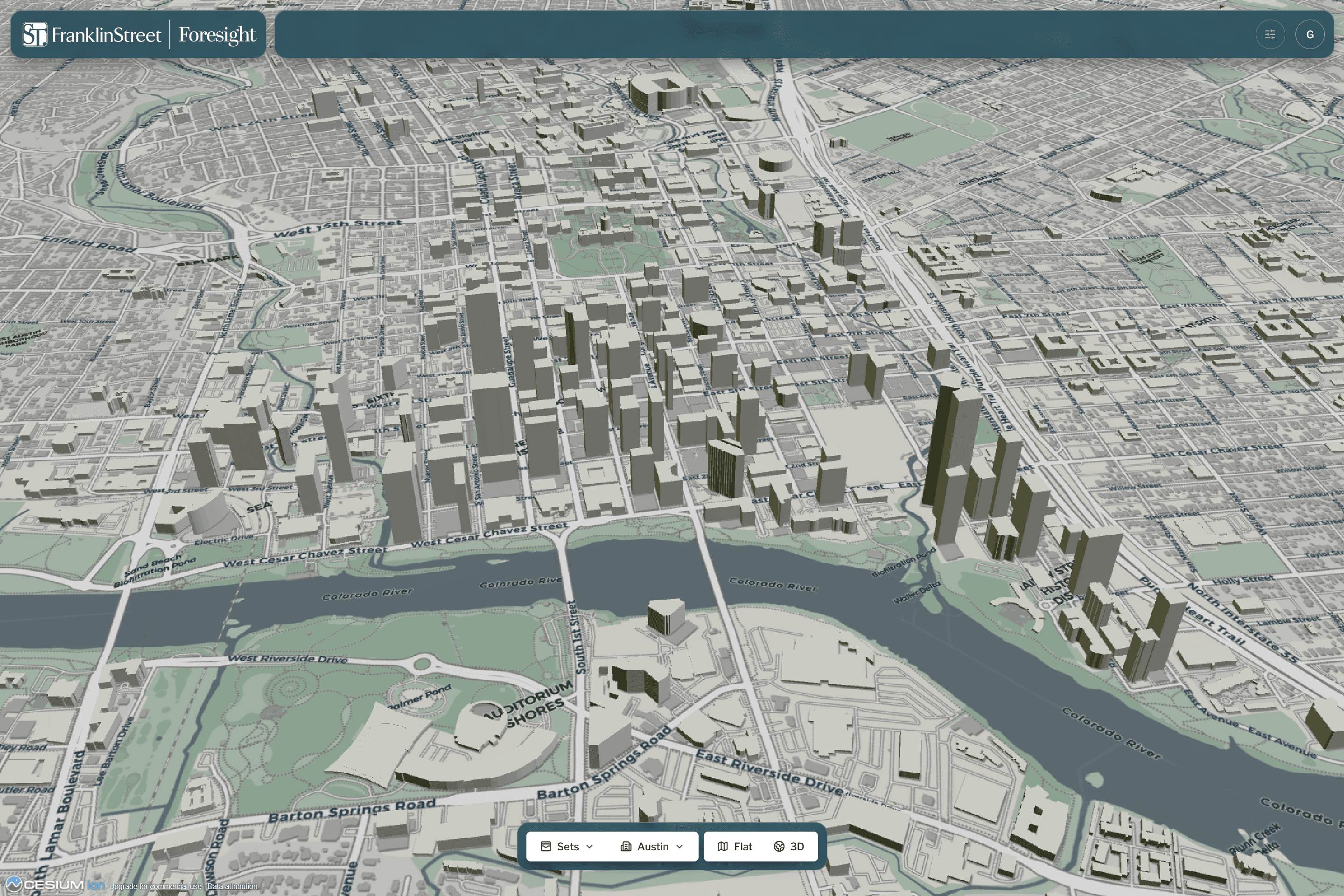
Make Earth the Interface
THE CHALLENGE
Most CRE tools reduce a building to a pin on a flat map with a box of specs sitting next to it. All the context that actually matters, the neighborhood, the scale, what the place feels like standing there, gets ignored.
THE SOLUTION
Clients get dropped onto a fully 3D Earth, and the building itself is actually there, not a marker floating above it. Data cards, comps, filters, everything floats over the map instead of boxing it in, so a property keeps its real context and presence.

02
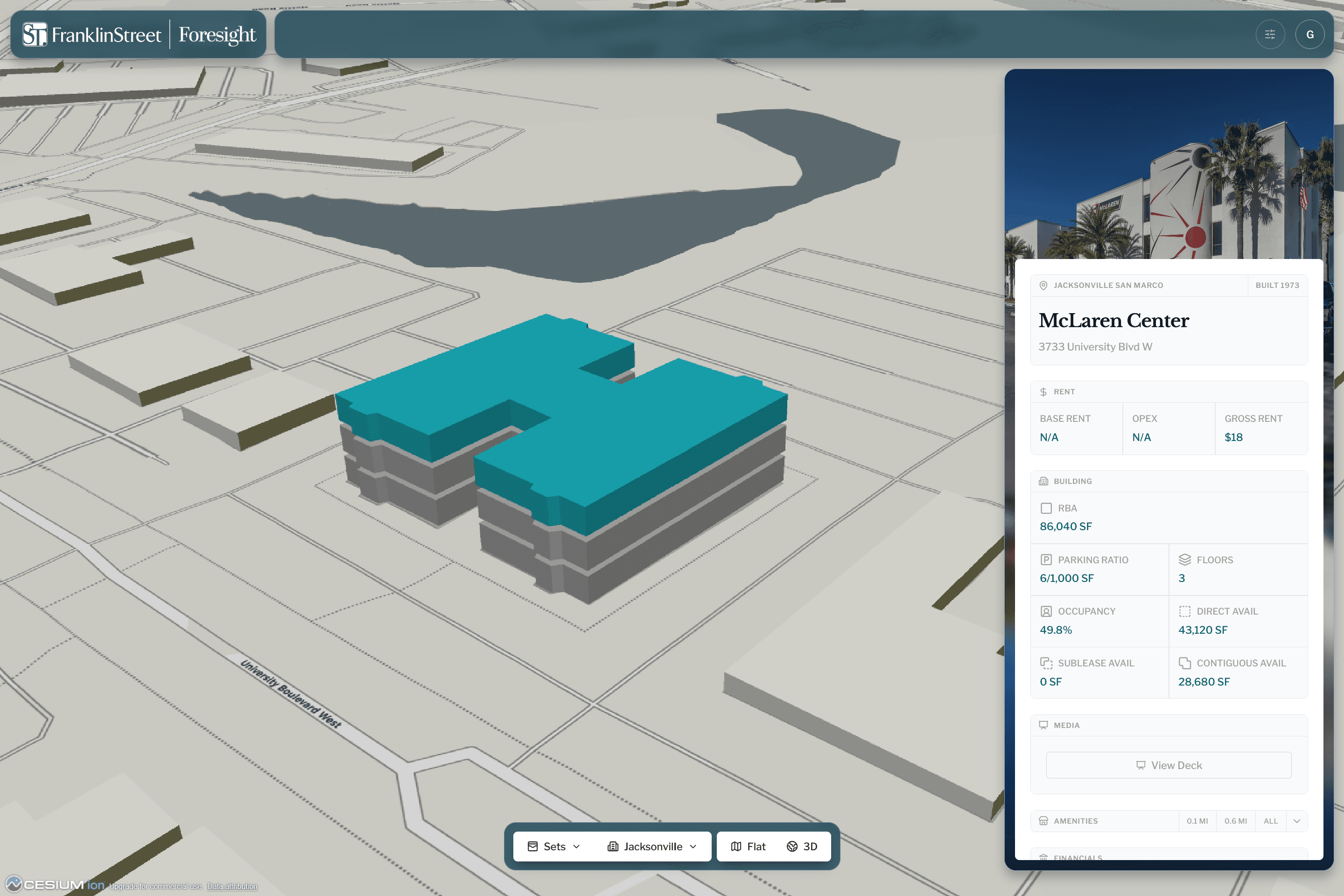
No Two Buildings are Alike
THE CHALLENGE
A downtown tower, a retail strip, and an apartment complex don't need the same information, but most tools force them into one rigid template anyway, or a developer ends up hand-building exceptions every time something doesn't fit.
THE SOLUTION
Building cards in Foresight are made of modular blocks that snap together. A card might be a quick look with a few numbers, or a dense, in-depth breakdown, depending on what the broker or client wants.
DOWNTOWN SKYSCRAPER
SUBURBAN OFFICE

03
One Hub for Everything
THE CHALLENGE
Brokers pull data from places like CoStar, then rebuild it by hand somewhere else entirely. In smaller markets, they're doing this over and over for the same buildings, deal after deal.
THE SOLUTION
Many platforms won't let you pull their data in automatically, so instead Foresight gives brokers a database of their own. Enter a building's info once and it feeds both the research and the pitch. Nothing needs to be copied, pasted, or rebuilt.

Solution
Foresight isn't really a dashboard where every field gets the same amount of attention. It's more of a space you explore. The 3D map sits at the center of the screen at all times, cards float over top of it rather than boxing it in, and the client's never just sitting there watching.
Nearby amenities show up in actual space. A client doesn't just hear what's nearby, they see it sitting right there.
Info panels are built from modular blocks, so brokers can push the right details forward depending on who's in the room.

Comp tables are modular too, and they give a client a fast, clean look at their options.
Live GIS data folds in real insight without messing with the polish of the presentation.
Impact
01
No more dev time
Brokers completely own their data. Changes that used to take days now take minutes.
02
Every property, one roof
High-rises to single-tenant buildings, brokers can present any of it without switching tools.
03
One build, national rollout
Adopted nationwide with zero custom dev work per market.
Reflection
This project was a great learning experience, first and foremost. I had ownership over the vast majority of the process and execution, from the architecture, to the interaction design, to the actual Cesium implementation. The most interesting thing I dove into was the strategic calls, which broker workflows mattered most, what "presentation-ready" meant for different people. These insights came from people who were a lot closer to the sales floor than I am. I felt like every day presented a new perspective and a new design problem for me to solve.
There is a lot of room to extend what Foresight is and what it can do. The tool itself is built to be flexible to the point where anyone with the right skills and tools can create whatever they would need. In the future, brokers can potentially generate any custom blocks they would need to take their presentations to the next level.